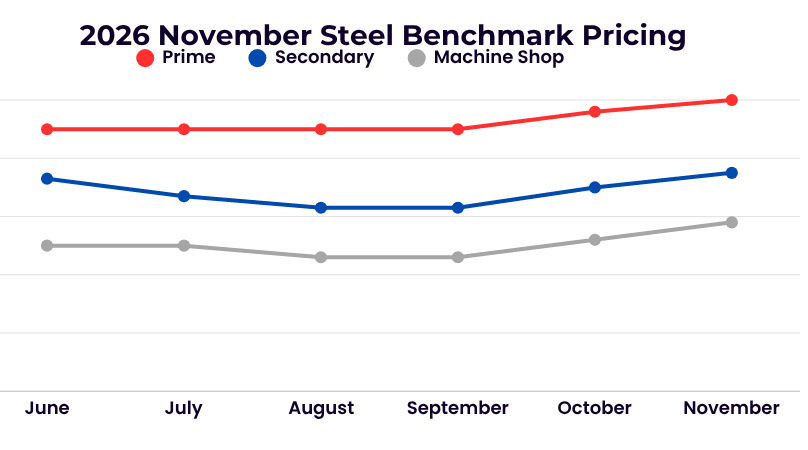
November market conditions strengthened across much of the scrap industry, with tighter supply, improving mill demand, and stronger steel pricing supporting both ferrous and nonferrous markets. Entering the final months of the year, domestic steel mills continued to maintain healthy order books while many planned maintenance outages concluded, allowing production levels and scrap purchasing activity to increase. Several market indicators pointed to stronger pricing momentum compared to the relatively stable conditions experienced during the spring and summer months.
Steel: Ferrous scrap prices moved higher across most grades during November. Improving mill demand, below-average scrap inventories, and slower inbound flows contributed to tighter market conditions. Prime grades, including busheling and bundles, remained well supported by strong steel production and healthy flat-rolled steel pricing. Obsolete grades such as shredded scrap and heavy melt saw some of the strongest gains as export activity improved and seasonal weather conditions began to tighten supply. Industry surveys indicated that many market participants expected further upward momentum, supported by strong demand and lean inventories throughout the supply chain.
Copper prices experienced significant volatility but continued to trade near historic highs. Supply concerns, strengthening infrastructure investment, electrification projects, and long-term demand from data centers and power infrastructure continue to support copper fundamentals. Despite periodic corrections, copper scrap values remain elevated relative to historical levels and continue to provide attractive returns for suppliers.
Aluminum markets remained relatively stable throughout November. Primary aluminum prices softened slightly during the first half of the month, but secondary aluminum demand remained healthy. Used Beverage Can (UBC) markets continued to perform well compared to historical norms, supported by strong recycling demand and can-sheet production. Broader aluminum scrap values remained supported by steady demand from packaging, transportation, and construction sectors, although pricing gains were more modest than those seen in copper.
LME Nickel remains stable with limited pricing pressure in either direction, while stainless demand softens heading into year-end. 304 and 316 scrap remain flat, as do Chrome stainless grades despite stronger iron values. Nickel stability is expected through year-end, although developments in Indonesia, the Philippines, or China could quickly shift market sentiment.
High-temperature alloys remain mixed, with select grades benefiting from stronger demand while others await mill direction. Titanium pricing remains steady, with meaningful relief not expected until Q4 2027.
Tool Steel and High-Speed Steel remain resilient despite weakness in Tungsten and Cobalt. Carbide and Tungsten alloys are holding for now, although near-term price erosion remains possible. Overall, mill purchasing appetite and year-end discounting continue to dictate Stainless and Alloy pricing. Despite optimism for a Q1 2027 recovery, subdued mill demand and uncertainty surrounding Nickel supply remain key market concerns.
Looking ahead, market fundamentals remain constructive as the industry approaches year-end. Ferrous scrap pricing is expected to remain supported by tighter supply, strong mill demand, and healthy steel pricing. Copper is likely to continue driving nonferrous market sentiment, with inventories, trade policy, and infrastructure spending remaining key variables. Aluminum and brass markets should continue benefiting from stable industrial demand and favorable recycling economics, although seasonal weather and holiday-related slowdowns may result in periods of reduced activity.